
Deepak Rustagi & Arti Rustagi
Management Consultant | AI Value Delivery Frameworks | Business Transformation
…
Walk into any executive meeting today, and you’ll hear the same question: “Where are the AI opportunities?”
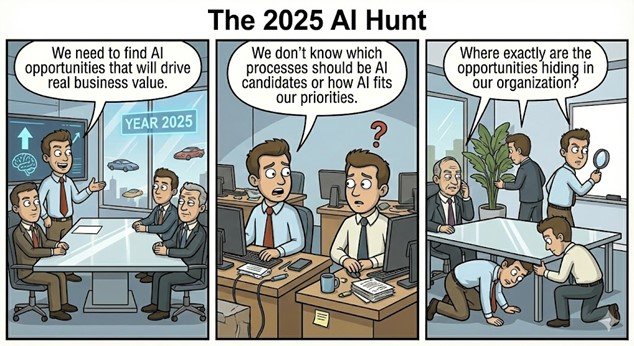
The result? Analysis paralysis. Organizations with massive AI potential can’t move because they lack a structured way to identify where AI delivers real value.
…
The Data Doesn’t Lie: AI’s Hidden Crisis
Despite the hype, the numbers reveal a sobering reality:
📊 74% of companies have yet to show tangible AI value[1]
📊 Only 2% of organizations are fully ready for enterprise AI across talent, strategy, data, and tech[2]
📊 Generative AI could unlock $2.6T–$4.4T annually—but most can’t find their share[3]
📊 Just 25% of AI initiatives deliver expected ROI[4]
The problem isn’t lack of potential. It’s lack of method.
…
The 3 Failure Patterns I See Every Week
As a management consultant working with organizations across industries, I’ve identified three consistent failures:
- Opportunity Identification Without Structure
Teams start with technology (“Let’s use ChatGPT here”), not business problems.
Result: Wishful thinking, not strategic decisions. No way to answer:
- Is this high-impact?
- Do we have the data?
- What’s the ROI timeline?
- Are we ready organizationally?
- Readiness Gaps Discovered Too Late
Organizations learn about readiness issues during pilots, not before:
- Data quality problems mid-project
- Skill gaps during deployment
- Integration issues after investment
- Cultural resistance when scaling
Result: Predictable failures disguised as “technical problems.”
- Stakeholder Misalignment
Executives want ROI. Practitioners need guidelines. IT worries about governance.
Without a shared framework, everyone talks past each other.
…
Why “Just Pilot Everything” Is a Trap
The standard advice: “Start small, pilot, iterate.”
The reality:
- Pilots waste resources on poorly-vetted ideas
- False negatives kill good opportunities due to readiness gaps
- Value delays as organizations chase shiny objects
- Team demoralization after repeated “failures”
Pilots test ideas. Frameworks validate opportunities.
…
Introducing: The AI Value Delivery Framework
After working with dozens of organizations struggling with this question, I’m developing a structured, workshop-based framework to answer it systematically.
What It Does:
- Business Problem Mapping
Start with: Where does the business hurt most? (Cost, time, errors, missed revenue)
- AI Opportunity Scoring
Evaluate against 5 criteria:
- Impact: Revenue/cost/customer value
- Data Readiness: Quality, governance, integration
- Technical Feasibility: Proven AI capability
- Org Readiness: Skills, culture, governance
- Timeline: 3mo, 6mo, 12+mo ROI
- Readiness Diagnostic
Before recommending, assess:
- Data infrastructure
- Team capabilities
- Systems integration
- Organizational maturity
- Phased Opportunity Roadmap
Not a laundry list. Yes to:
“Start here (quick win). Prepare for this next. Delay this until ready.”
- Workshop Format
2-3 day facilitated session where:
- Practitioners surface real problems
- Executives provide strategic context
- IT assesses feasibility
- Team builds the roadmap together
Ownership is organizational, not consultant-driven.
…
The Framework in Action (Simplified Example)
Organization: Mid-size financial services firm
Problem: Loan approval takes 5 days, 23% abandonment rate
Step 1: Map business pain → $2.3M lost revenue opportunity
Step 2: Score opportunity → High impact, medium data readiness, proven AI (decision automation)
Step 3: Readiness diagnostic → Data OK, skills gap in ML ops, infrastructure ready
Step 4: Roadmap →
- Phase 1 (3mo): Auto-prequalification (80% of volume)
- Phase 2 (6mo): ML decision engine
- Phase 3 (12mo): Full end-to-end automation
Result: Clear path, aligned stakeholders, confidence in execution.
…
Why this Framework works where others doesn’t
Most AI approaches focus on implementation.
This framework focuses on upstream opportunity identification.
It answers the three questions everyone asks:
- Where? High-impact opportunities, not random pilots
- Are we ready? Data-driven readiness assessment
- When? Sequenced roadmap with quick wins first
…
Framework Status: Draft & Open for Feedback
The framework is in active development. Current components:
✅ Opportunity Assessment Methodology
✅ Readiness Diagnostic Tool
✅ Workshop Structure
✅ Roadmap Sequencing
⏳ Implementation Playbooks (next)
⏳ Industry Templates (next)
⏳ ROI Measurement Framework (next)
…
This is where we come in
If you’re struggling with “Where are the AI opportunities?” I want to hear from you.
I’m seeking:
- Organizations for pilot workshops (2-3 days)
- Practitioners sharing their real challenges
- Executives frustrated by failed pilots
- Feedback to refine the methodology
Drop a comment: What’s your biggest challenge identifying AI opportunities?
- Don’t know which problems are AI-solvable
- Readiness gaps kill projects
- Stakeholder misalignment
- Other?
Or DM me your story @ icestrategychief@gmail.com. Let’s build this together.
…
The opportunities exist. They’re just hidden behind lack of structure.
Let’s find them.
#AI #ArtificialIntelligence #BusinessTransformation #AIStrategy #DataStrategy #Leadership #ValueRealization
Sources:
- https://www.bcg.com/press/24october2024-ai-adoption-in-2024-74-of-companies-struggle-to-achieve-and-scale-value
- https://www.infosys.com/newsroom/press-releases/2024/enterprise-ai-readiness.html
- https://www.mckinsey.com/capabilities/tech-and-ai/our-insights/the-economic-potential-of-generative-ai-the-next-productivity-frontier
- https://fortune.com/article/ceos-ai-initiatves-fraction-deliver-return-on-investment-roi-study/